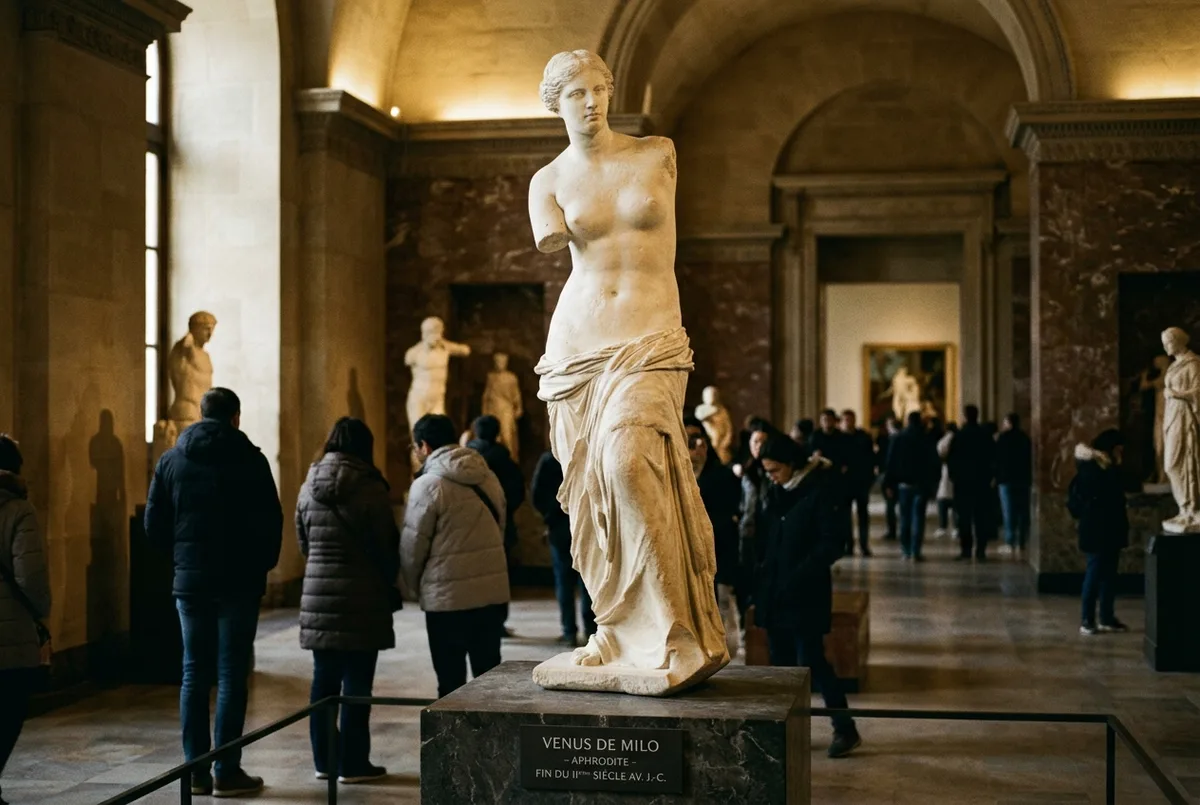
The Venus de Milo and the Winged Victory of Samothrace are the two sculptures most referenced alongside the Mona Lisa as the Louvre’s “must-see” set, and both are genuinely worth the short walk from the painting galleries. I’d treat them as a pair rather than picking just one, since they sit close enough together that skipping either costs you almost no extra time.
Where Is the Venus de Milo Located in the Louvre?
The Venus de Milo stands in the ground-floor Greek antiquities galleries of the Sully wing, in a room built specifically to showcase the statue on its own, lit from above. It’s one of the few major pieces in the museum that gets a room largely dedicated to itself rather than sharing space with dozens of other works.
I’d use that dedicated room as a landmark if you’re trying to navigate the ancient Greek galleries generally. Once you’ve found the Venus de Milo, the surrounding rooms of Greek, Etruscan and Roman antiquities are easy to explore from that same starting point.
Why Is the Venus de Milo Missing Its Arms?
The statue was discovered in 1820 on the Greek island of Milos (also spelled Melos) by a farmer, already missing both arms, and no convincing fragments of them have ever been recovered despite extensive searching. The sculpture is believed to depict Aphrodite and dates to roughly 100 BC, in the Hellenistic period of Greek art.
I’d push back gently on the idea that the missing arms are a flaw. Plenty of art historians argue the statue’s ambiguity, no one knows for certain what the original pose held, is part of why it’s remained so compelling for two centuries, and I genuinely agree with that read after seeing it in person described by people who have studied it closely.
What Is the Winged Victory of Samothrace?
The Winged Victory of Samothrace depicts Nike, the Greek goddess of victory, caught mid-stride as if landing on the deck of a ship, with dramatically windswept drapery carved to suggest real movement. French archaeologist Charles Champoiseau discovered the sculpture in 1863 on the island of Samothrace, and it dates to roughly 200 to 190 BC.
I’d call this one of the most technically impressive pieces of ancient sculpture anywhere, missing head and arms included. The way the drapery clings to the figure’s body while the fabric behind her appears to catch the wind is the kind of detail that photographs genuinely fail to capture.
Why Does the Winged Victory Stand at the Top of a Staircase?
The sculpture has stood at the top of the Daru staircase since 1884, a deliberate curatorial choice that lets the figure’s forward, downward motion play off the architecture beneath it. One recovered fragment of the statue’s right hand is displayed separately nearby, since it wasn’t found until decades after the main piece.
I’d specifically recommend approaching from the bottom of the staircase rather than from the side if you can. Seeing the full height of the statue build as you climb is a genuinely different experience than walking up to it from a side gallery entrance.
Which Sculpture Should You See First?
Most guided routes see the Winged Victory first, since it typically sits closer to the Pyramid entrance and the Daru staircase connects naturally toward the painting galleries beyond it. The Venus de Milo sits a bit further into the Sully wing’s antiquities section.
I’d follow that same order if you’re navigating on your own: Winged Victory first, then the Venus de Milo, then on to the paintings. Going the opposite direction works fine too, but it tends to mean more backtracking through the same corridors.
Are These Sculptures Worth Visiting If You’re Short on Time?
Yes, and I’d prioritize them over several lesser-known paintings if you’re genuinely tight on time. Both sculptures take only a few minutes each to appreciate properly, and both sit directly on the natural walking route between the Pyramid entrance and the Mona Lisa room, so visiting them costs you almost no detour time at all.
My honest advice: don’t let a tight schedule talk you out of these two. I’ve seen rushed itineraries skip straight to the Mona Lisa and miss two pieces that, in my view, are just as impressive and considerably less crowded.

How Do These Sculptures Connect to the Louvre’s Painting Highlights?
Both sculptures sit on the same general route through the Denon and Sully wings that leads to the Mona Lisa, Liberty Leading the People and the other headline paintings, which is why most visitors naturally see all of it in a single loop. My top 10 things to see at the Louvre places both sculptures alongside the paintings and the architecture worth building a route around.
I’d genuinely recommend reading that fuller list if you want a complete route plan rather than just the sculpture detail covered here.
What Do These Two Sculptures Have in Common?
Both are Hellenistic Greek works, both were discovered on Greek islands in the 19th century, and both are missing limbs that were never recovered, yet both still rank among the most recognizable sculptures in the world. I think that’s the most interesting thread connecting them: incompleteness that somehow never diminished their reputation.
My honest read is that this shared history is worth knowing before you see them, not just as trivia but because it reframes what you’re looking at. Neither statue survives exactly as its sculptor intended, and I’d argue that gap between the original and what remains is part of what makes standing in front of either one feel genuinely significant.
Is It Worth Reading Up on These Sculptures Before You Visit?
I’d say yes, briefly. Knowing that the Venus de Milo likely depicts Aphrodite and that the Winged Victory represents Nike landing on a ship’s deck gives you something concrete to look for, rather than appreciating either purely on visual impact alone. Neither sculpture carries a detailed on-site placard explaining the full context, so a few minutes of reading beforehand genuinely changes what you notice.
I wouldn’t over-prepare, though. I’d rather you walk in knowing the basics and spend your actual time looking rather than reading, since the sculptures themselves reward attention far more than background trivia does.
Where Do They Fit in the Louvre’s Broader Antiquities Collection?
Both sculptures sit within a much larger collection of Greek, Etruscan and Roman antiquities that spans dozens of rooms across the Sully wing, most of which see far less foot traffic than these two headline pieces do. If ancient sculpture genuinely interests you beyond just the two most famous names, I’d budget extra time to wander the surrounding galleries.
My honest take is that most visitors treat the Venus de Milo and Winged Victory as a quick photo stop on the way to the Mona Lisa, and I think that undersells a collection that rewards a slower look. If ancient art is even a mild interest of yours, I’d carve out a dedicated half hour for this wing alone, separate from your painting-focused route.
My Honest Recommendation
I’d see both sculptures on your way toward the Mona Lisa rather than treat them as a separate trip, since the walking distance between all three is short and the extra time cost is minimal. If you only have time for one, I’d pick the Winged Victory, purely because its staircase setting makes it feel more dramatic in person than photos of the Venus de Milo convey.
For the painting highlights that share this same route, my Louvre paintings guide covers the Mona Lisa and the rest of the headline works in full. And once you’ve settled on which pieces matter most to you, my Mona Lisa tickets guide covers the ticket types that get you to this whole route fastest, or my louvre ticket and tour options homepage has the complete current lineup if you want to compare every format first.
Frequently Asked Questions
Where is the Venus de Milo in the Louvre?
In the ground-floor Greek antiquities galleries of the Sully wing, in a room largely dedicated to the statue itself.
Why doesn’t the Venus de Milo have arms?
The statue was discovered in 1820 already missing both arms, and no convincing original fragments have ever been recovered.
Where is the Winged Victory of Samothrace displayed?
At the top of the Daru staircase, where it has stood since 1884, positioned to play off the architecture beneath it.
Can you see both sculptures in a short visit?
Yes, both sit on the natural walking route between the Pyramid entrance and the Mona Lisa room, so seeing both costs very little extra time.